
From Goats to Bytes: A Rural Community’s Leap into the Digital Age
No matter where you are, inside a classroom or far beyond its walls, access to digital technology and the Internet holds enormous potential to sharpen educational skills. Yet, in many rural settings, barriers such as geographic isolation, limited transportation, cultural norms, and socioeconomic realities combine to widen the digital disconnection gap (Ahiaku, Uleanya, & Muyambi, 2025). To help bridge this divide, the Mawingu Foundation is working directly with the pastoral community of Il-Ngwesi to implement an innovative, locally grounded solution that expands and sustains Internet connectivity.
Last September, during a recent visit to Il-Ngwesi—a community nearly four hours from Nairobi, the capital of Kenya, in Isiolo County—our team at the Internet Society Foundation witnessed firsthand how this community is harnessing its resources in creative ways to stay connected and thrive. In this blog, we share some insights from their journey so far and explore how Mawingu’s and Il-Ngwesi’s community-based approach is not only closing the digital gap locally but also modeling a clever approach for other pastoral communities across Kenya.
The Mawingu Foundation project “Sustainable holistic digital inclusion of Community Anchor Institutions (CAIs) in Garissa, Wajir, and Isiolo Counties in Kenya,” funded by the Internet Society Foundation as part of the Building Opportunities/Leveraging Technologies (BOLT) grant program, has focused on connecting anchor institutions (schools, hospitals, and clinics) at the community level to the Internet, in underserved areas in rural and peri-urban areas in North-Eastern Region and Upper Eastern Region of Kenya. This project builds on Mawingu’s expertise in deploying and leveraging existing connectivity infrastructure at subsidized rates, made possible through Mawingu Networks Operator. This approach has been successfully piloted in other counties in Kenya. Through their work, the Mawingu Foundation also aims to create self-sustaining models for community digital access, ensuring long-term benefits and scalability across East Africa.
This vision becomes most tangible when you step into Il-Ngwesi, a community of around 500,000 people, where just months ago, reliable Internet access was still out of reach. In a broader sense, Il-Ngwesi faces similar issues with connectivity in this region, including a lack of infrastructure and the high cost of data, which significantly limit the community’s access to the Internet, particularly for young learners. Research has shown that without regular access to technology, learners in rural schools are less likely to develop digital literacy skills that are essential for modern education and future employment opportunities (Fikuree et al., 2021). Through the BOLT grant, the Mawingu Foundation has addressed this issue by fostering key partnerships to provide reliable and affordable Internet access to this community.
A first milestone of this project has been the creation of a Community Resource Center, or as some call it, the community hub, housed in a space donated by the local school. Other partner NGOs have contributed books to stock up a library, while the local Rotaract Club donated 10 desktop computers. With Internet access now a reality in the hub, another significant milestone is soon to take place here with the launch of the needs assessment, which will shape the digital skills trainings. Charles Watiri, Head of Impact at Mawingu Foundation, further explains, ‘digital needs vary from one community to the other depending on the gaps within that community, but there are areas where the gaps cut across all the communities. The input is usually given by the community digital leaders (those people whom the community perceives as their experts in digital matters).
The training phase is a continuation of the community-based approach where the Mawingu team organizes activities based on the train-the-trainer model (often called Community Digital Champions – CDCs) by the team, after which they will be responsible for cascading the skills learned to the rest of the community members to build the capacity of digital literacy skills, online learning tool use, and digital marketing.
Speaking to different community members, it is clear how strong the support has been so far for the project. When asked about the initial stages of setting the digital hub’s infrastructure, Jayo Ngunje, community center manager, says, “When the community leaders heard what this could mean for our children, there was no hesitation; they all supported it.” And it shows. The layout of the digital hub intentionally distributes the space to meet the needs of the community and prioritizes children. The walls of the resource center are yet another reminder of the community’s involvement and vision, for the art and murals on the walls are creations of the young adults of the community. By designing a dedicated children’s zone, the Il-Ngwesi Community Resource Centre enables young mothers interested in digital training to comfortably participate while the children play. Students and children come to read and access computers; teenagers gather in the afternoons to practice typing or browse educational videos; and elders stop by simply to take part in the excitement, fostering true inclusivity in community development.
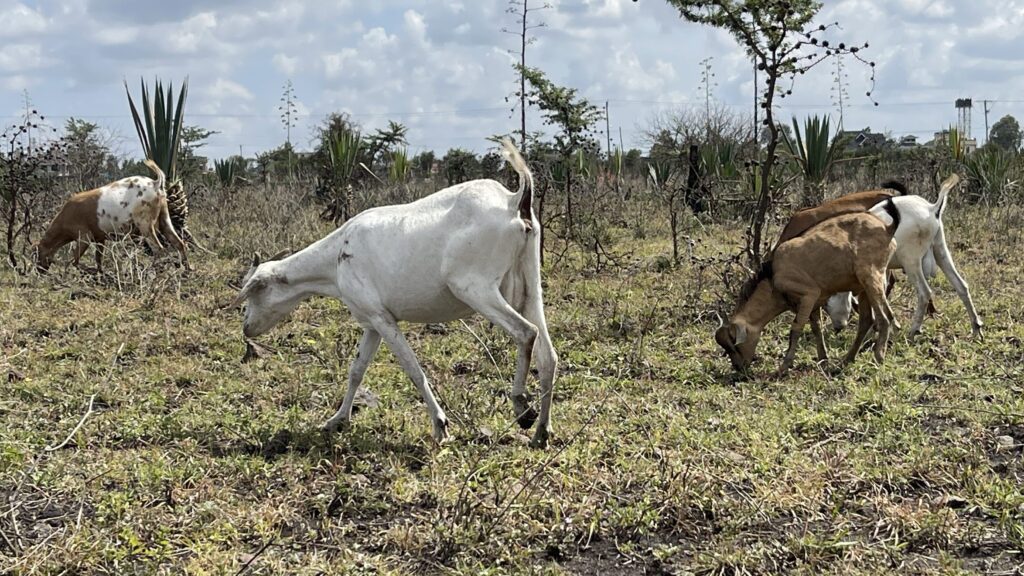
Beyond the hub’s functional infrastructure, its true strength lies in the way the community has woven local traditions and livelihood practices into sustaining its operation for the long term. Although the Internet costs are subsidized by the Mawingu Foundation, the community has taken it a step further with an initiative they call “Sell a goat, keep the community hub running.” Every three to four months, families pool their resources by designating a goat for sale, with the proceeds used to cover the Internet subscription. Local herders support this investment and plan ahead, deciding which goat will go toward this shared commitment. By rotating the responsibility among families, the cost is shared equitably, making the hub a truly collective effort. As the hub manager explained, this sense of ownership has transformed the Community Resource Centre into far more than an Internet access spot — it has become a gathering place, drawing people who walk or ride motorbikes for over 20 kilometers to access books, the Internet, and the vibrancy of community life.
Projects such as this from the Mawingu Foundation are a powerful example of community-driven solutions. Clearly, the community of Il-Ngwesi finds value in this hub and what it means for their present and future. Perhaps the most telling sign of a perception shift was when we were listening to an elder speak about his new appreciation for the opportunities the Internet can bring and why it matters to him. Looking at children huddled around computer screens, he reflected, “It did not happen for us, but it can happen for the children.” The Il-Ngwesi hub shows that when communities take ownership of digital inclusion, connectivity becomes more than access—it becomes a pathway for opportunity, innovation, and broader change.
A special thank you to Charles Watiri (Head of Impact), Millie Abila (Head of Communications) and Lucy Wairimu (Project Manager) for the support and insights that helped shape this blog.
Ahiaku, P.K.A., Uleanya, C. & Muyambi, G.C. Rural schools and tech use for sustainability: the challenge of disconnection. Educ Inf Technol 30, 12557–12571 (2025).
Fikuree, W., Shiyama, A., Muna, A., Naseer, B., & Mohamed, Z. (2021). Challenges to education during the COVID-19 pandemic: A SIDS perspective with special reference to the situation in the Maldives. International Education Journal, 20(2), 5–22.