
Digital Inclusion for Youth with Hearing and Speech Disabilities
In Bangladesh, young persons with disabilities particularly those with severe physical, visual, intellectual, hearing, and speech disabilities continue to face persistent exclusion from education, skills development, and employment. Even when academically qualified, many remain unemployed due to attitudinal barriers, inaccessible infrastructure, and digital discrimination. Employers often prefer candidates with mild disabilities, leaving those with more severe conditions consistently overlooked.
To respond to this long-standing inequality, Access Bangladesh Foundation, with support from the Internet Society Foundation’s SCILLS Program, launched the project “Making Digital Skills Accessible for Youth with Disabilities and Promoting Their Economic Inclusion in Bangladesh.” The initiative aims to equip 400 youth with disabilities nationwide with essential digital skills, create self-employment opportunities for 150 graduates, and secure 50 formal job placements within a 24-month period.
One of the most meaningful milestones of the project has already begun reshaping the landscape of inclusive training in Bangladesh: the launch of the first-ever exclusive online Graphic Design training batch for youth with hearing and speech disabilities.
A First-of-Its-Kind Training Opportunity
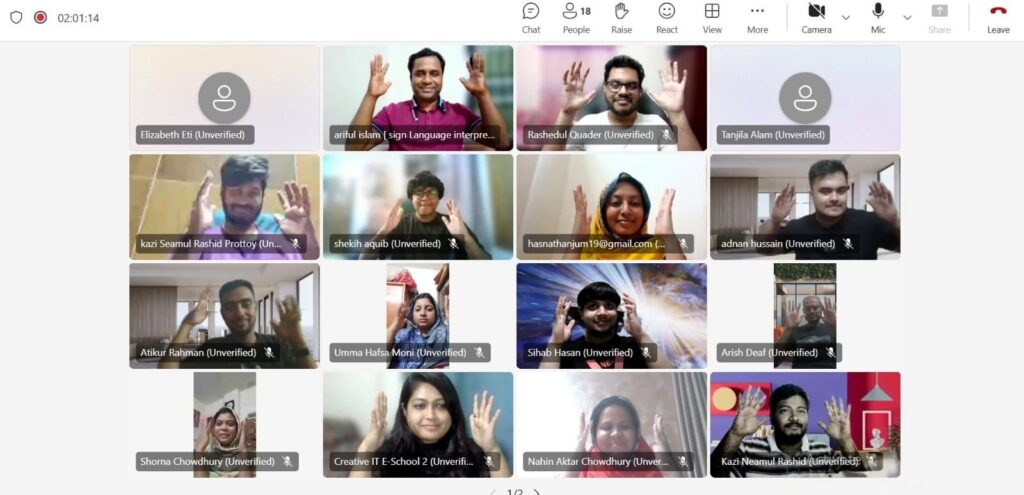
When Access Bangladesh proposed this idea to Creative IT Institute, one of the country’s most reputable training providers, the initial response was cautious. The institute had never provided online training for learners with hearing disabilities, and their trainers were unfamiliar with sign language. While they typically run online classes of 40–50 students, this special batch required limiting enrollment to 15 learners and incorporating a professional sign language interpreter. This meant rethinking teaching methods, pacing, and resource allocation.
Access Bangladesh offered a simple yet powerful solution: a professional sign language interpreter would attend every online class and translate each lesson in real time. This would give learners full communication access while allowing trainers to teach as usual. After thoughtful planning and several discussions, Creative IT agreed to pilot the model.
A New Learning Experience and New Possibilities
On the first day of class, 15 young learners with hearing and speech disabilities five women and ten men from both urban and rural areas logged in to begin their training. Many had dreamt for years of learning graphic design but had never encountered an accessible training environment. With interpreter support, visual learning aids, and flexible teaching strategies, their confidence has grown steadily.
Nahin Akter Chowdhury, one of the female participants, shared:
“I tried to enroll in graphic design courses before, but there were no sign language interpreters, and trainers were not willing to give me extra time. I kept searching and finally found this class designed for learners like me. I feel relieved and confident now to learn graphics design properly.”
Over six months, learners are mastering foundational design principles color theory, layout, typography, and visual hierarchy and practicing with industry-standard tools such as Adobe Photoshop, Illustrator, and InDesign. Their creativity is emerging through logo designs, posters, and digital graphics.
For Kazi Seamul Rashid, who grew up with a sibling who also has a hearing and speech disability, the experience has been transformative:
“Before enrolling, my skills were very limited. Now I can use Photoshop and Illustrator confidently. I can edit photos, create layouts, and design visuals on my own. These skills helped me believe in my abilities and opened opportunities for freelance work.”
Some learners have already begun taking on small community-based freelance tasks, bringing income, pride, and a renewed sense of possibility into their lives.
Building Pathways to Economic Inclusion
Upon completing the course, participants will be equipped to work as freelance designers or office-based graphic design assistants. They will be able to earn through online marketplaces, social media content creation, and printing services. For many, this marks their first real pathway to financial independence and meaningful participation in the digital economy.
This special training batch demonstrates a powerful truth: when accessibility and reasonable accommodation are prioritized, young people with disabilities can acquire digital skills, earn income, and thrive.
A Reflection for the 2025 International Day of Persons with Disabilities
As the world marks the International Day of Persons with Disabilities on 3 December 2025, under the theme “Fostering disability-inclusive societies for advancing social progress,” this story stands as a compelling example of what is possible when institutions commit to inclusion.
The experience of these young learners shows that equal access to digital opportunities is not only achievable but is transformative. Their journey highlights the shared responsibility of training institutes, organizations, and communities in building truly inclusive digital ecosystems.
This initiative is more than a training program. It is a model for a more inclusive future one where young people with disabilities in Bangladesh can unlock their potential, contribute to their communities, and shape their own economic futures.